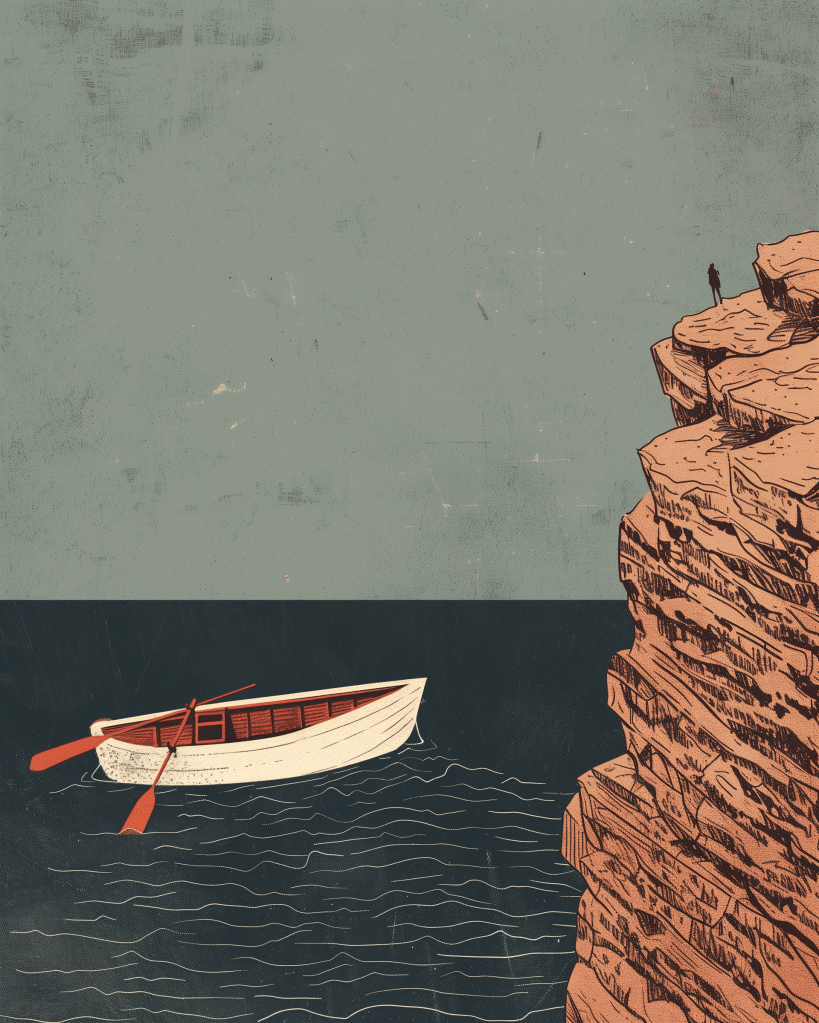
In many cultures, prayer begins at the edge of agency.
Not in the sense that it replaces effort, though that is how it is sometimes caricatured, and not in the sense that it guarantees rescue, which is often how it is sold. Prayer, in its oldest public form, tends to appear where the human hand reaches its limit. It is a language for admitting scale: the sea is larger than the boat, the weather larger than the plan, history larger than the individual life trying to remain coherent inside it.
The modern world has not outgrown this impulse. It has merely redistributed it.
We have migrated our petitions into new shrines. The glowing rectangle receives its daily offerings. A refresh gesture becomes a small rite. An algorithm, unnamed but felt, seems to decide what is shown, what is withheld, what counts. We do not call this prayer, because the word has acquired too much incense and too many claims. Yet the structure is familiar: a turning outward at the moment our own effort feels insufficient, a request directed into something large and partly opaque, a hope that the unseen machinery will lean kindly.
Hunter S. Thompson’s line, brisk as a slap of saltwater, interrupts the temptation to confuse humility with passivity: “Pray to God, but row away from the rocks.” It is the kind of sentence that travels because it makes room for contradiction without trying to reconcile it. Reverence, in one hand. Oar, in the other. The body moving even as the mind admits it does not command the wind.
Thompson is not usually filed under devotional literature. That is part of the point. Certain ideas are too necessary to remain housed in their original institutions. They escape into jokes, into aphorisms, into the back pocket of a person who would never call themselves religious. When a sentence lasts, it often does so by being useful to people who disagree about everything else.
It helps that the sentence is nautical. Water insists on clarity.
At sea, the relationship between faith and technique is not an abstract debate. It is an arrangement made in real time with consequence attached. The prayer may be genuine, or it may be simply the mind’s way of finding a steady rhythm under fear. The rowing is nonnegotiable. In a storm, it is possible to be comforted by the thought of providence and still capsize from a bad angle. The ocean does not punish disbelief and reward belief. It responds to physics.
This is sometimes mistaken for bleakness. It is closer to mercy. The sea’s indifference can feel like a clean surface. It refuses to flatter our narratives. It grants no special exception for sincerity. It offers, instead, a kind of equality: anyone can learn to read a chart; anyone can misjudge a current.
There is an older story hidden inside Thompson’s quip, a story that keeps resurfacing whenever humans have to steer through forces that do not care about their wishes.
In the Odyssey, Odysseus is repeatedly undone not by a lack of courage but by misalignment between desire and circumstance. He can want home with all his heart and still drift for years. He can be clever and still be delayed by weather, by gods, by his own crew’s hunger. Ancient myth locates the human being between appetite and fate, between craft and caprice. It frames the world as a place where one must act, and still not pretend to control.
A modern person may not recognize Poseidon in the wave.
Yet the underlying predicament survives in secular clothing. We inhabit systems too complex to be grasped in full. The market moves without asking our consent. The climate responds to accumulated choices made by many hands, most of them not ours. A virus travels with the intimacy of air. A rumor spreads faster than the correction. A small mistake in a network can become a large failure elsewhere. We row, and still, the rocks appear.
It is tempting, in such conditions, to convert prayer into a technology. If one says the right words, with the right posture, to the right force, the desired outcome will arrive. This is one of the oldest mental seductions. It is also one of the most durable.
Anthropologists have long noticed that ritual proliferates in domains of high uncertainty and high stakes: fishing in dangerous waters, hunting in unpredictable terrain, navigation where the margin between success and catastrophe is thin. The ritual does not necessarily replace skill. It accompanies it. It gives the nervous system something to hold while the rest is unholdable. It creates a sense of pattern where randomness would otherwise be intolerable.
Modernity likes to imagine it has left this behind, replacing ritual with evidence. Yet the evidence itself does not soothe. It describes.
Knowing the statistics of disaster rarely diminishes the feeling of vulnerability. Knowing the probability of survival does not make the moment of risk feel less singular. Knowledge has its own stern beauty, but it is not designed as comfort. Often it increases awe. The more one learns about weather systems, the more one understands how much weather is. The more one learns about cognition, the more one sees how easily the mind confuses meaning with causation.
This is where Thompson’s sentence gains its quiet force. It refuses the most common evasions.
It does not sneer at prayer. It does not romanticize it. It does not accuse it of being childish. Nor does it pretend that effort is a guarantee. It simply places the two in the same boat and asks them to coexist without pretending to merge.
There is a psychological version of this tension that unfolds far from any shoreline.
In moments of crisis, many people discover two competing instincts: the urge to outsource responsibility and the urge to overclaim it. One says, something will save me. The other says, everything depends on me. Both can be forms of panic. Both can be attempts to abolish uncertainty.
The first is the fantasy of rescue. The second is the fantasy of control.
Between them is a narrower stance, less dramatic, more difficult to dramatize on a poster: the decision to act without the emotional guarantee of success. The decision to row even when the water does not promise to cooperate. The decision to accept that not everything can be prevented, and still not surrender to drift.
Risk science, when it is most humane, tends to describe something similar. It distinguishes between hazards that can be reduced and hazards that must be lived with. It recognizes that safety is not a single state but a moving boundary. It makes room for the odd fact that a person can do everything correctly and still be harmed, and that another person can behave recklessly and survive. It refuses to turn outcomes into moral verdicts.
In other words, it has a kind of ethics without sermon.
So does seamanship. So does medicine. So does parenting. So does any practice conducted under conditions of partial knowledge.
There is a reason Thompson chose rocks, not storms.
Storms are dramatic. Rocks are quiet. They wait.
Most calamities are not cinematic. They are incremental. A small assumption goes unexamined. A small maintenance task is delayed. A small boundary is crossed repeatedly until it no longer feels like a boundary at all. The rocks are often visible. They are simply judged as far enough away. The mind has a talent for turning distance into permission.
To row away from the rocks is not heroic. It is often boring. It is a steady refusal of drift.
That is part of what makes the line feel culturally relevant in an era saturated with spectacle. Many contemporary crises have the shape of rocks: slow-moving threats, long gradients, consequences that accumulate. Climate change is not a monster, it is a shoreline changing by inches and then, suddenly, by miles. Misinformation is not a single lie, it is a cumulative erosion of shared reference. Burnout is not a dramatic collapse, it is the daily choice to ignore small signals until the body insists on being heard.
Prayer, in this context, can be understood as an acknowledgment of dependence. Not dependence as weakness, but dependence as description. Human life is contingent. It is nested. It is never fully self-authored.
Rowing, then, is the refusal to let that description become an excuse.
A culture’s maturity might be measured by how it handles this pairing. Some eras glorify providence and blame individuals for lacking faith. Other eras glorify autonomy and blame individuals for failing to optimize. Both styles turn complexity into a morality play.
Yet the world remains stubbornly uninterested in our preferred narrative structure. It continues to be larger than the individual, and also responsive to individual actions. It continues to be shaped by forces that can be studied, and also punctuated by randomness. It continues to require skill, and also to laugh at skill. It continues to allow meaning, and also to refuse to validate meaning through outcomes.
In that stubbornness is a peculiar invitation.
To live without guaranteeing. To speak to what is larger without pretending it will answer. To move the body with care even when the mind cannot secure the future.
Thompson’s line is short enough to fit on a matchbook, and dense enough to hold a whole ethic: reverence without superstition, effort without arrogance, humility without collapse. It belongs to no single tradition, which is perhaps why it survives. It is portable. It works in a chapel and on a fishing boat and in a therapist’s office and in the quiet moment before a difficult conversation.
It is also incomplete, as all honest sentences about living tend to be.
Because the hardest part is not knowing that one should row. The hardest part is knowing what counts as rowing, when the rocks are not literal, when the danger is social or internal or systemic, when the currents are invisible and the map is contested, when the act of pulling an oar feels, on some days, indistinguishable from staying in place.
If prayer is one way of admitting scale, and rowing is one way of refusing drift, what do we call the discernment that tells us which direction is away from the rocks?
 The Brilliant Lamp
Leave a comment