(On Power, Sacrifice, and Why Our Stories Can No Longer Finish the Myth)
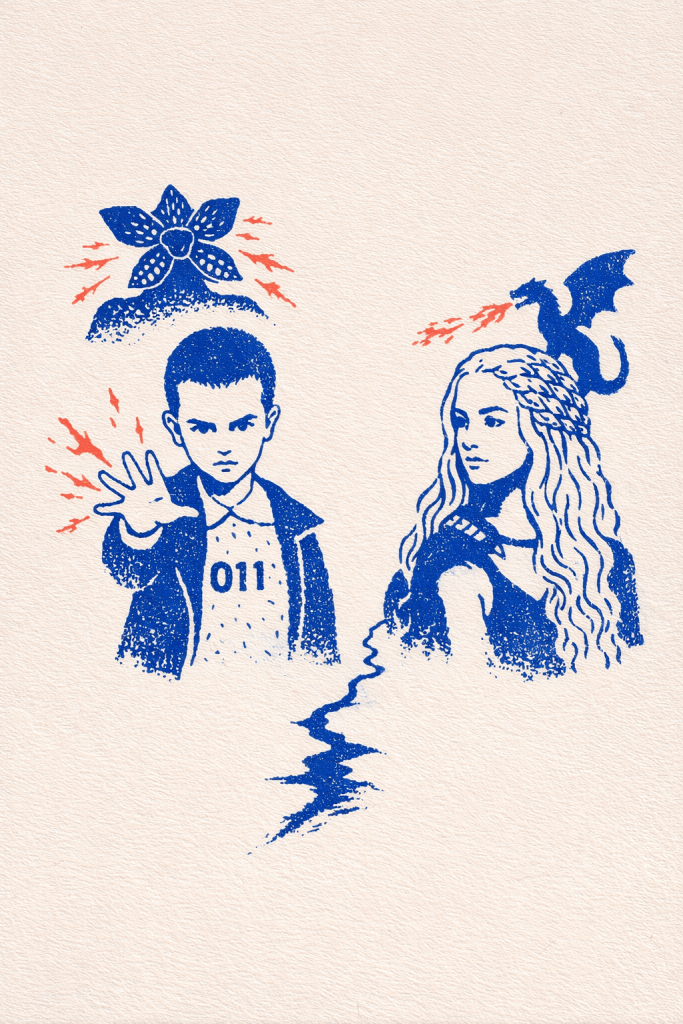
Every age tells the story it most needs to hear, often before it understands what that story is doing or why it has begun to repeat itself.
When societies are stable, stories tend toward ornament and innovation. When societies fracture, narrative returns to a more ancient function: orientation. Meaning arrives not as explanation, but as structure capable of holding uncertainty without collapse.
Ours is such a moment.
With striking consistency, contemporary storytelling has returned to a figure both ancient and newly reconfigured: Christ consciousness understood as a form of awareness heavy enough to require a human body to carry it.
Two of the most influential television narratives of the past decade – Stranger Things and Game of Thrones – arrive independently at this figure. Each centers a young woman whose story follows a familiar but unresolved rhythm: descent, sacrifice, apparent death, and an ending that gestures toward resurrection without completing it.
This restraint functions less as narrative coyness than as cultural diagnosis.

The Archetype Beneath the Story
Carl Jung understood the Christ figure not primarily as a religious symbol, but as an image of the Self (the psyche’s organizing principle) emerging when fragmentation becomes unsustainable.
Such figures surface when a culture can no longer distribute its contradictions across ordinary life. Someone must carry what the many cannot.
Joseph Campbell traced this pattern across civilizations. The hero descends not to conquer darkness, but to encounter what has been exiled from awareness. The return, when it occurs, does not restore innocence. It alters perception.
What distinguishes our present retelling is not the pattern itself, but where its burden lands.
The figure tasked with holding this awareness is no longer king, priest, or warrior. She is young. She is female. And the cost is paid somatically.
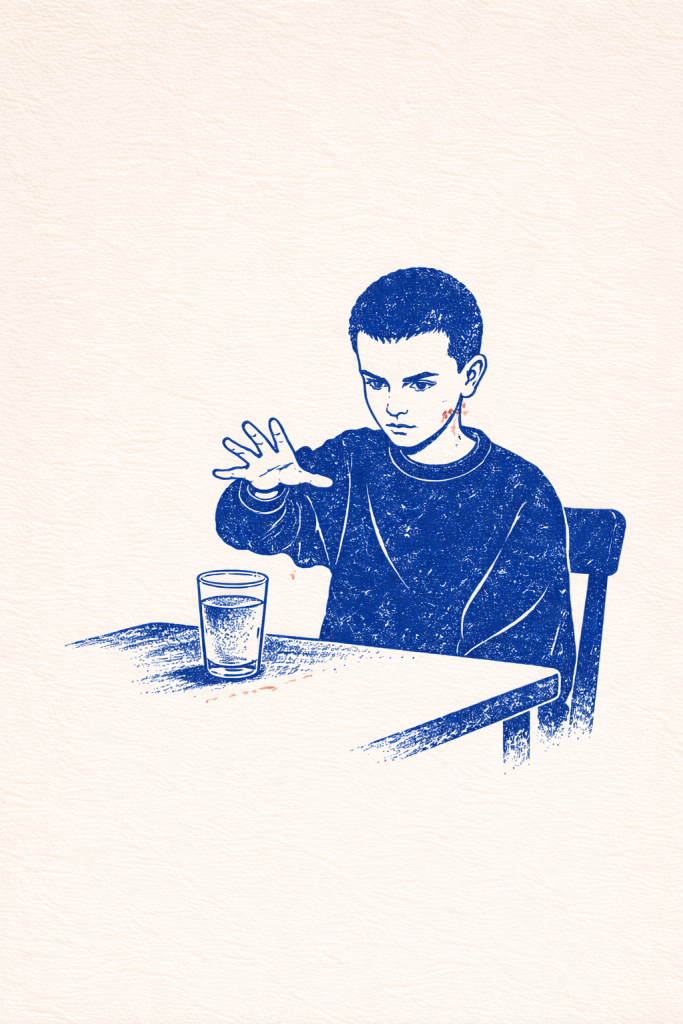
Eleven: Awareness as Load-Bearing Capacity
Eleven enters Stranger Things without social language, lineage, or symbolic insulation. Power arrives in her nervous system before meaning arrives in her mind.
Her abilities do not function as gifts. They operate as conduits.
Each act of intervention exacts a physiological toll. Blood appears. Strength diminishes. Salvation leaves residue behind.
The Upside Down functions less as an alternate dimension than as a psychological underworld, populated by what has been disowned: fear, rage, grief, and collective trauma.
Eleven does not purify this realm. She holds it long enough for others to survive.
Marguerite Porete, writing centuries earlier, described a similar movement of the soul: the gradual relinquishing of mastery until the self becomes transparent to something larger.
This does not occur through discipline or virtue. It occurs through exhaustion, through love taken seriously enough to undo the one who loves.
Eleven’s story is not one of victory. It is one of endurance.
When she disappears, presumed dead, the narrative resists resolution. The world does not heal in her absence. It destabilizes instead.
Her return is muted, altered, provisional. Resurrection appears not as an event, but as a condition that must be sustained.
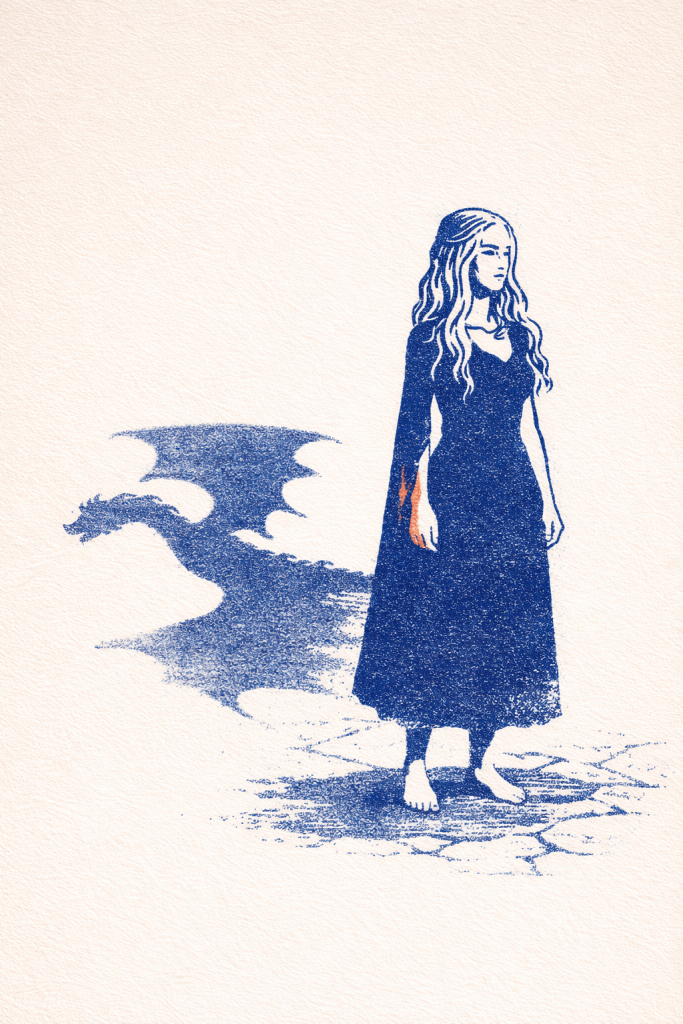
Daenerys: When the Archetype Hardens
Daenerys Targaryen begins closer to traditional messianic form. She is reborn through fire, fulfills prophecy, and frees the enslaved, gathering followers who recognize the familiar shape of deliverance.
Yet Game of Thrones undertakes a more difficult inquiry. It examines what happens when symbolic power fuses with identity.
Daenerys does not descend into the underworld. She projects it outward.
Fire becomes corrective rather than illuminating. Destiny hardens into certainty.
Hannah Arendt warned that violence most often arises not from cruelty, but from conviction… from the belief that one’s vision of the good justifies force.
Daenerys does not fail because she seeks justice. She fails because justice ceases to include restraint.
Her death offers no closure. The body is carried away. The story refuses resurrection.
The silence instructs more than any resolution could.
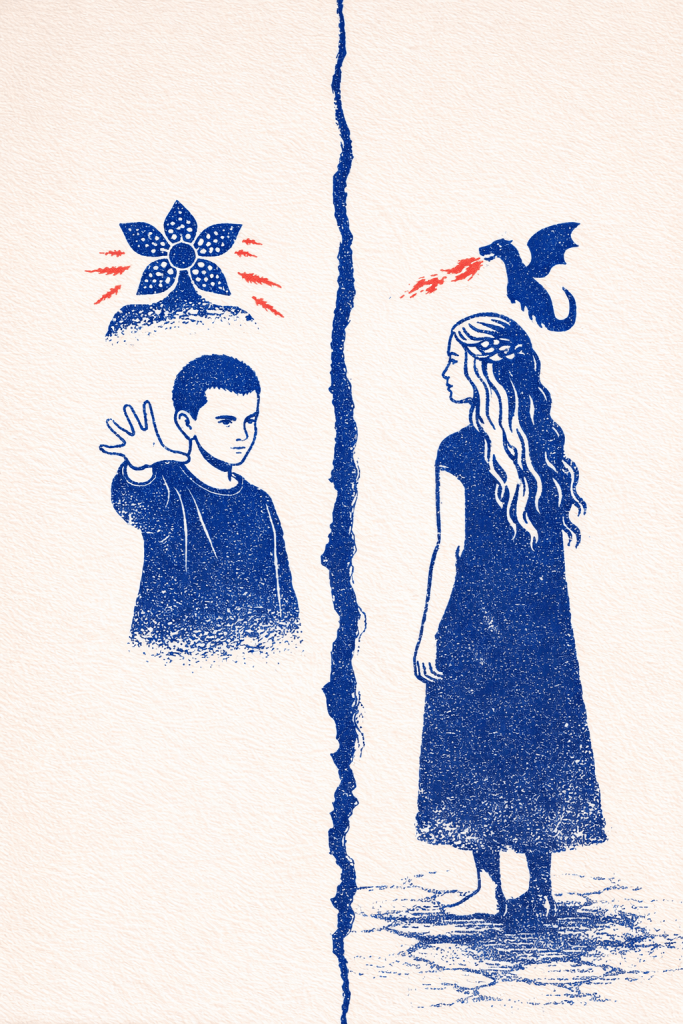
Archetypes as a Field, Not a Cast
In both narratives, the surrounding characters function less as psychological individuals than as symbolic roles: the witness, the guardian, the betrayer, the skeptic, the chronicler.
Together, they form an ecosystem that reveals where attention flows.
Simone Weil understood attention as a moral act… the capacity to remain present without attempting to dominate what is seen.
These stories quietly ask whether attention will bend toward care or toward control.
The Christed figure does not act alone. She reveals the configuration of the whole.

Why Resurrection Is Withheld
Resurrection myths emerge when cultures sense that continuation without transformation has become impossible.
They appear when inherited structures persist beyond their capacity to generate meaning, even as they continue to exert power.
Our era is marked by institutional fatigue, ecological precarity, and accelerating systems untethered from shared ethical ground. Authority persuades less. Narratives fragment faster than they cohere.
In such conditions, stories perform a subtle maneuver. They rehearse renewal while refusing to complete it.
What they provide is not resolution, but a structure strong enough to sustain paradox.
Resurrection can no longer be delivered by a singular figure. It must be assumed collectively.
That these stories center young women reflects a shift in how power is being imagined: away from conquest and toward endurance, away from dominance and toward the capacity to remain conscious under pressure.
The Ethics of the Unfinished Ending
Myths that resolve too note-perfectly turn into instructions. Those that remain unfinished ask something of the reader.
Neither Eleven nor Daenerys is granted a completed resurrection because the culture itself has not yet agreed on what resurrection means, or what it should cost.
Will it be enforced or chosen. Will it arrive through force or through integration. Will it demand speed, or patience.
The stories stop at the moment where responsibility begins.
They hold open the question of whether awareness can expand without hardening into certainty.
What follows depends on how we respond.
 The Brilliant Lamp
Leave a comment